
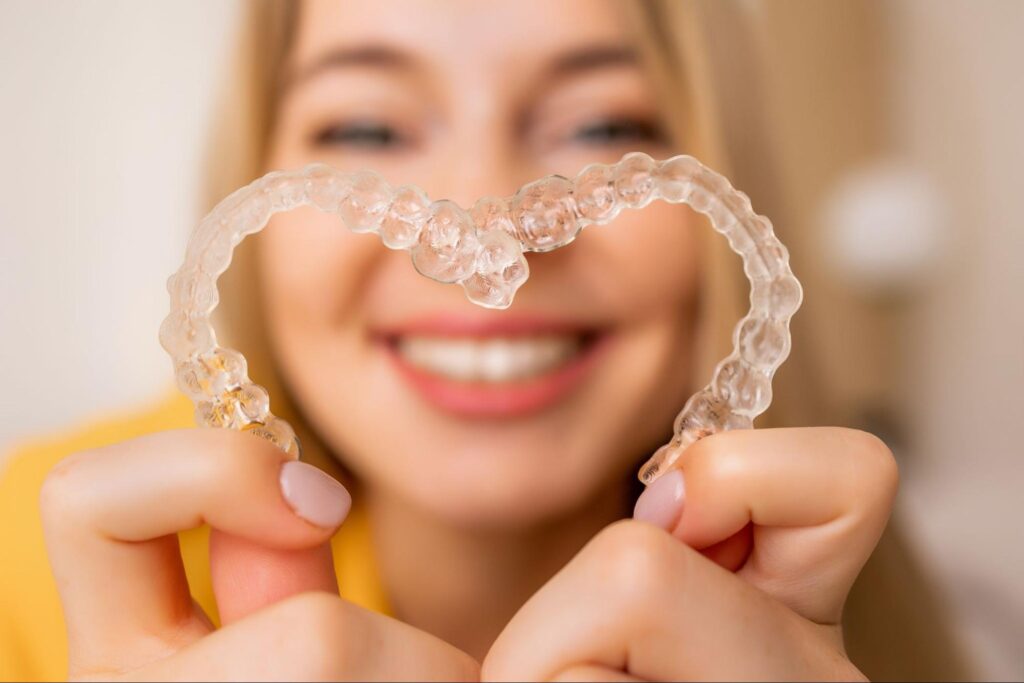
Clear aligners are a nearly invisible way to straighten teeth without brackets or wires. Instead of fixed metal hardware, you wear a series of custom trays that shift your teeth a little at a time. They come out for eating and brushing, sit comfortably against your gums, and fit into everyday life without much fuss. For mild to moderate crowding, gaps, and bite concerns, they offer a discreet path to a straighter smile.
Aligners fit busy lives. Whether you are a teen heading to class or an adult juggling work and family, treatment works around your day instead of taking it over.
What Are Clear Aligners?
Clear aligners are a set of custom-fit plastic trays that move teeth using gentle, controlled pressure. Most are made from a medical-grade thermoplastic that flexes over your teeth and nudges them toward their target positions a fraction at a time. The Invisalign system we use at Stewart Smiles is the most widely known version of this approach.
Unlike traditional braces, aligners are removable and close to see-through. You wear each set for one to two weeks before swapping to the next tray in the series. Every tray is slightly different, mapped out ahead of time with digital 3D modeling so each one moves specific teeth a little closer to where they need to be.
Aligners handle a wide range of alignment concerns, including crowding, gaps, overbites, underbites, crossbites, and open bites. The technology has been refined steadily since the late 1990s, and millions of teens and adults have used it to straighten their smiles without anyone ever knowing they were in treatment.
How Do Clear Aligners Work?
Clear aligners work in three main steps. A digital scan creates a 3D map of your teeth, you wear custom trays 20 to 22 hours per day, and you switch to the next set every one to two weeks. Each tray moves your teeth slightly closer to their final position, with most patients finishing in 12 to 18 months.
The process starts with a digital iTero scan, so no goopy impressions required. Dr. Stewart, DDS, MSD, uses that scan to plan exactly how each tooth needs to move, mapping out a treatment sequence built for your smile.
You receive a series of trays, each a little different from the last. Wear them 20 to 22 hours a day, taking them out only for meals and brushing. Every one to two weeks, you move to the next set.
Check-ins happen every six to eight weeks so your orthodontist can confirm everything is tracking as planned. Most patients finish in 12 to 18 months, though timelines depend on the case. Better still, the digital scan lets you preview your projected results before you even begin.
Key Benefits of Clear Aligners
Here is what patients tend to love most about treating with aligners.
Are Clear Aligners Really Discreet?
Yes. The trays blend right in, and most people will not notice you are wearing them. For adults and teens who feel self-conscious about braces, that makes a real difference. You can straighten your teeth without changing how you show up at work, school, or social events.
Can You Remove Aligners for Meals and Photos?
Pop them out for meals, photos, or special occasions. No food restrictions to worry about, and no awkward pictures with brackets stealing the spotlight.
Are Aligners Easier to Keep Clean?
Brushing and flossing stay simple. No threading floss around wires or weaving past brackets. You clean your teeth the way you always have, then rinse the trays and pop them back in.
Do Clear Aligners Feel Comfortable?
They feel smooth, not pokey. The medical-grade plastic sits gently against your gums and cheeks, with none of the wire ends or bracket edges that can irritate the inside of your mouth.
Will Aligners Save You Time?
Visits happen less often than with braces, which works well for full schedules. Most check-ins take only a few minutes since there are no wires to tighten.
Can You See Your Results Before You Start?
The digital preview shows your projected smile before treatment begins, so you have a clear picture of the finish line from day one.
Clear Aligners vs Traditional Braces
Still weighing braces against aligners? This breaks down the key differences.
| Feature | Clear Aligners | Traditional Braces |
|---|---|---|
| Appearance | Clear, nearly invisible | Visible metal or ceramic brackets |
| Comfort | Smooth plastic, minimal irritation | Wires and brackets can rub cheeks |
| Removability | Yes, for eating and cleaning | Fixed throughout treatment |
| Diet | No restrictions | Avoid hard, sticky, crunchy foods |
| Oral Hygiene | Brush and floss normally | Requires special tools and extra time |
| Visit Frequency | Every 6 to 8 weeks | Every 4 to 6 weeks for adjustments |
| Best For | Mild to moderate cases | Complex cases, severe bite concerns |
Both options work well. Braces handle more involved situations like severe rotations and significant bite corrections. Aligners shine for mild to moderate crowding, gaps, and bite concerns where discretion matters most. A thorough evaluation is the only way to know which one fits your situation.
What Affects the Cost of Clear Aligner Treatment?
Pricing depends on a handful of factors tied to your specific case. The biggest drivers are case complexity, total treatment length, provider experience, and your insurance coverage. Simpler cases with fewer trays cost less, while longer, more involved treatments take more time and materials.
- Case complexity. More trays and longer treatment usually mean a higher cost.
- Treatment duration. Simpler cases take less time and cost less.
- Insurance coverage. Many orthodontic plans cover aligners similarly to braces.
Nationally, clear aligner treatment tends to land somewhere in the low thousands, though your actual number depends on your case. A consultation is the only way to get a figure that means anything for your smile.
Who Is a Good Candidate for Clear Aligners?
Aligners work well for many patients, though they are not the right fit for everyone. Good candidates usually include:
- Teens and adults with mild to moderate crowding, gaps, or bite concerns.
- Patients with healthy teeth and gums. Untreated decay or gum disease needs attention first.
- Committed wearers who can keep trays in 20 to 22 hours a day.
- Anyone wanting a discreet option for professional or personal reasons.
- Patients with fully erupted permanent teeth, though younger kids have early options too.
Aligners may not be ideal for severe skeletal bite concerns, major tooth rotations, or more involved needs. If you are weighing clear aligner treatment in Franklin, TX, a free exam is the fastest way to find out whether you are a candidate. Dr. Stewart can evaluate your smile and point you toward the approach that actually fits.
Frequently Asked Questions
Do clear aligners hurt?
A little, at first. Most patients feel mild pressure for the first day or two with each new tray, which is a sign it is doing its job. The discomfort is usually less than a braces adjustment, and it fades quickly as your teeth settle in. Over-the-counter pain relievers help during those first 48 hours if you need them.
How long does clear aligner treatment take?
Average treatment runs 12 to 18 months, though your timeline depends on your case. Simple corrections can finish sooner, sometimes in as little as six months. More complex movements take longer, occasionally up to two years. Your orthodontist maps out your expected timeline at your first exam so you know what to expect.
Can I eat with clear aligners in?
You take them out to eat, so you get zero food restrictions. Enjoy popcorn, apples, gum, whatever you want. Just brush before putting the trays back in so food particles do not get trapped against your enamel.
How often will I see the orthodontist?
Every six to eight weeks works for most patients. These visits are quick since there are no wires to adjust. The team confirms your teeth are tracking, hands over your next sets of trays, and sends you on your way.
Are clear aligners as effective as braces?
For mild to moderate cases, yes. Published research supports clear aligners for treating crowding, spacing, and many bite concerns. More involved cases may still do better with braces, which is why a proper evaluation matters before you choose a path.
Will I need a retainer afterward?
Yes. Retainers hold your teeth in their new positions after active treatment ends. Without them, teeth naturally drift back over time and undo your progress. Your orthodontist will set you up with retainers and a wear schedule to protect your results for years.